
-
 Call Us +0757 82252350
 -
 Email Us manager@gdboanmachine.com


Capsule Filling Machine Buyer's Guide: In-Depth Reviews of 5 Top Models & Core Technology Analysis
In the production lines of the health supplement and pharmaceutical industries, the capsule filling machine is undeniably core equipment. Whether you aim to establish a small R&D laboratory or operate a large-scale cGMP production workshop, choosing the right filling solution is critical. This article provides an in-depth review of five mainstream capsule filling machines and outlines the key processes in capsule production, helping you make an informed purchasing decision.
We will categorize the equipment based on their primary application scenarios: Powder Filling Solutions and Liquid Filling Solutions.
Powder filling is the most common process in capsule production today. Catering to different capacity requirements, the market offers a range of options from manual intervention to full automation.
For startups, small to medium-sized enterprises (SMEs), or R&D laboratories, an economical, flexible, and reliable device is the ideal starting point. The semi-automatic single-head filler is designed precisely for such scenarios.
Its operation requires an operator to manually transfer the capsule plates between stations, but the machine itself handles core processes like capsule separation, filling, and locking. Its key advantages are:
High Cost-Effectiveness: Low initial investment, perfect for users with limited budgets needing a quick project start-up.
User-Friendly: The single-head design simplifies operation; new operators can become proficient in a short time.
Flexible Changeover: Quickly switch between different capsule sizes (like Size 00, Size 1) by changing mold sets, ideal for multi-variety, small-batch production.
Compact Footprint: Occupies minimal floor space, easily integrating into smaller cleanrooms or laboratories.
This machine is a reliable "workhorse" for small-batch, high-mix production of specialized supplements.
As your business grows and capacity demands increase, but you're not quite ready for a fully automatic line, the semi-automatic dual-head model offers an excellent intermediate solution.
It adds a second filling head to the single-head base, achieving a significant leap in production capacity without a massive price increase. Its main advantages include:
Doubled Output: The dual-head design can theoretically double production efficiency compared to the single-head model.
Optimized Efficiency: Supports either two operators working simultaneously or one skilled operator achieving a much faster production pace.
Robust Construction: Built with high-quality stainless steel, capable of withstanding high-intensity, long-term daily use.
Precise Dosing: The upgraded filling mechanism ensures high consistency in powder fill weights even at higher speeds.
For growing mid-sized companies seeking a significant production boost, the dual-head semi-automatic machine is an ideal "bridge" connecting startup phase and large-scale production.
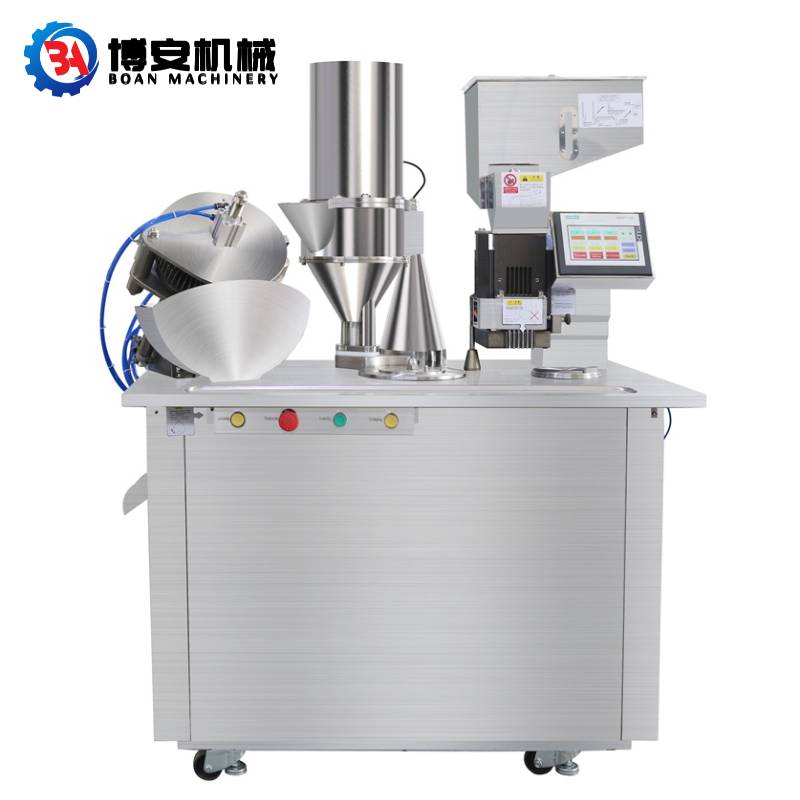
For enterprises requiring large-scale, high-speed continuous production, the fully automatic capsule filling machine is a true "production" (mainstay). Once the operator loads empty capsules and materials, the machine automatically completes all processes without human intervention.
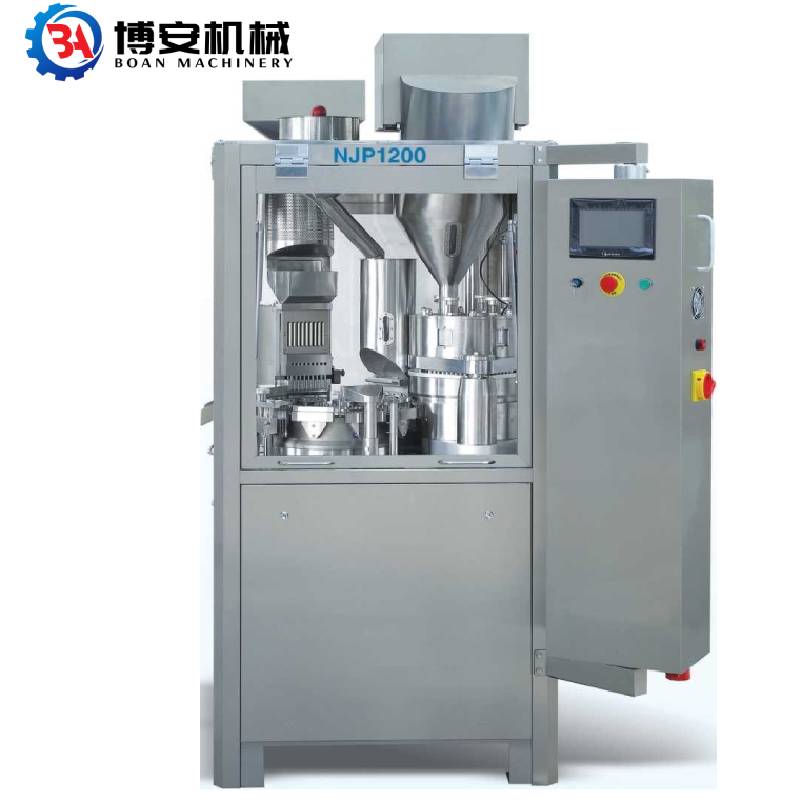
Taking the typical NJP-1200 model as an example, its core value lies in:
Massive Production Capacity: Achieves speeds of approximately 1,200 capsules per minute (over 70,000 per hour), easily handling large-volume orders.
cGMP Compliant: Fully enclosed design effectively prevents dust leakage, meeting strict pharmaceutical manufacturing hygiene standards.
Intelligent Control: Equipped with an advanced PLC touchscreen control system for real-time monitoring of speeds, weight adjustment, and fault diagnosis.
High Yield Rate: Precision capsule orientation and filling mechanisms ensure an extremely high yield rate, virtually eliminating capsule waste.
For commercial-grade manufacturers, such equipment significantly reduces labor costs per unit and maximizes return on investment.
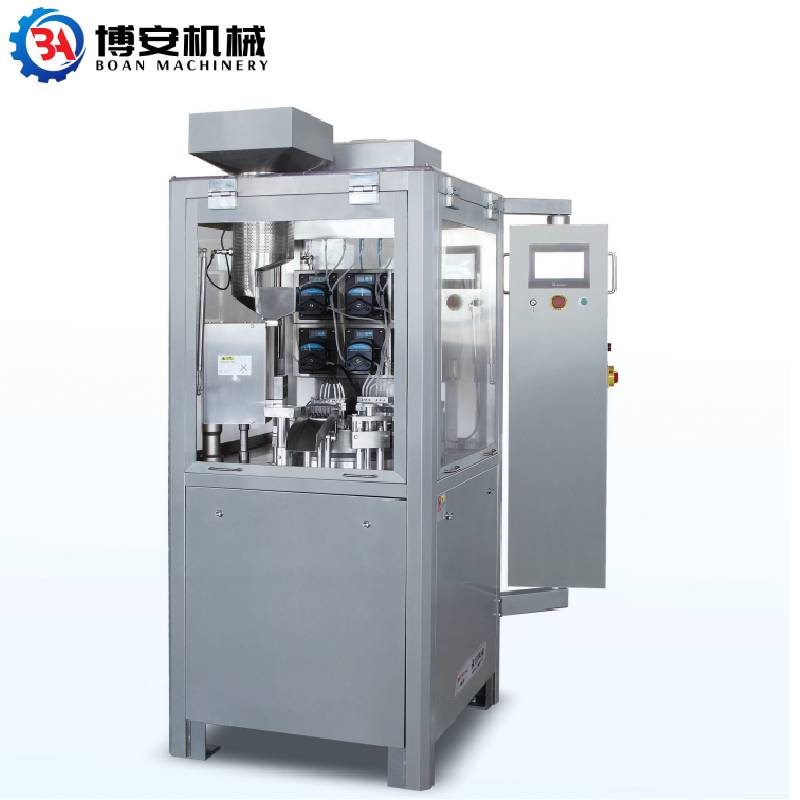
With the growing market demand for high-bioavailability oils, liquid vitamins, and similar products, liquid capsule filling technology is becoming increasingly important.
Filling liquids (especially oils, suspensions, or pastes) into hard capsules requires specialized technology to prevent leakage. Fully automatic liquid filling machines are designed for this purpose.
It uses high-precision pumps to inject a metered amount of liquid into the capsule body, followed by perfect sealing. Its technical highlights include:
Ultra-High Precision: Utilizes advanced ceramic pumps, ensuring liquid dosage accuracy down to the microgram level.
Temperature Control System: Equipped with heated hoppers and piping, crucial for viscous liquids or pastes that need warming to improve flowability.
Seamless Integration: Works perfectly with downstream equipment like capsule banding machines to ensure liquid capsules are completely leak-proof.
Full Automation: Like its powder counterpart, it operates continuously, requiring minimal supervision for high output.
For brands focusing on premium Omega oils, CBD liquids, or complex vitamin formulations, this is the ideal equipment for achieving scaled, high-quality production.
Not every liquid project requires large-scale automation. For pilot batches or small-scale specialty production, a liquid filler adapted from a semi-automatic platform offers a more flexible entry point.
It retains the reliable framework of the semi-automatic series while being equipped with specialized liquid dosing mechanisms. Its advantages are:
Low Entry Barrier: Allows small and medium brands to enter the profitable liquid capsule market with a lower initial investment.
R&D Friendly: An ideal tool for R&D laboratories conducting small-scale trials and process development for new formulations.
Easy to Clean: Designed with the cleaning needs of liquid equipment in mind, supporting quick disassembly and washdown.
Broad Viscosity Adaptability: Can handle a wide range of liquid viscosities with simple tooling changes.
This machine is a "multi-purpose tool" serving niche markets, formulation development, and process validation.
Owning a great machine is only half the battle; mastering the correct production processes and maintenance methods is equally critical.
Whether using semi-automatic or fully automatic equipment, commercial capsule production follows a core workflow:
Formulation & Blending: Ensure active ingredients and excipients are mixed uniformly. Powders must have good flow properties.
Loading Materials: Load empty capsules and the blended powder/liquid into the machine's respective hoppers.
Capsule Separation: The machine automatically aligns capsules and separates caps from bodies, typically using vacuum.
Precise Filling: Using powder dosing pins or liquid metering pumps, the material is accurately filled into the capsule bodies.
Capping & Sealing: The machine reattaches the caps onto the filled bodies and locks them securely.
Ejection & Polishing: Finished capsules are ejected and usually passed through a polisher to remove any residual surface dust.
Proper maintenance is the secret to extending equipment life and ensuring stable, reliable operation.
Daily Maintenance: At the end of each shift, use an industrial vacuum to remove all residual powder. Wipe down all contact parts with food-grade alcohol. Inspect the sorting mechanism for any jammed, deformed capsules.
Weekly Maintenance: Disassemble dosing discs, filling pins, and hoppers for thorough cleaning and complete drying. Check all vacuum lines and filters; clean or replace as needed. Apply food-grade lubricating oil to moving cams and chains.
Monthly Maintenance: Check the alignment of filling stations to prevent bent pins. Inspect the electrical panel for loose wires. Recalibrate fill weights.
A well-maintained capsule filling machine can easily operate stably for over a decade.
What is the main difference between semi-automatic and fully automatic capsule filling machines?
The core difference lies in the level of manual intervention required. Semi-automatic machines require an operator to manually transfer capsule plates between stations (separation, filling, capping). Fully automatic machines perform all these steps continuously within an enclosed system without manual intervention, resulting in higher speeds and lower labor requirements.
Can one machine fill both powders and liquids?
Generally, no. Powders and liquids require completely different filling mechanisms. Powder filling relies on gravity, volume, or piston-based methods (e.g., tamping pins), while liquid filling necessitates high-precision pumps and sealed nozzles. Machines are typically designed for one specific material type.
What capsule sizes can these machines handle?
Mainstream models offer high flexibility. By purchasing and changing specific mold/tooling sets, they can typically accommodate all standard capsule sizes, including 000, 00, 0, 1, 2, 3, 4, and 5.
Is it difficult for beginners to learn to operate these machines?
Semi-automatic models are designed to be very intuitive, and beginners can usually become proficient within a few days. Manufacturers typically provide clear user manuals and user-friendly interfaces to simplify the training process. Fully automatic models require more systematic training.

 Jinhai Plaza, No. 21, Jihua 5th Road, Chancheng District, Foshan City, Guangdong Province, China
  +0757 82252350
  +8618613054883
  manager@gdboanmachine.com