
-
 Call Us +0757 82252350
 -
 Email Us manager@gdboanmachine.com


This white paper aims to provide a professional guide for the selection and build-out of core production equipment for tablets and capsules, targeting engineering technicians, production managers, and project decision-makers in the pharmaceutical and nutritional supplement industries. It systematically elaborates on the process characteristics of different dosage forms (including plain tablets, coated tablets, chewable tablets, effervescent tablets, multi-layer tablets, modified-release tablets, and hard/soft capsules), their corresponding key production equipment, and the logic behind constructing cGMP-compliant production lines. The paper includes detailed equipment comparisons based on production scenarios, professional answers to no fewer than ten common technical questions, and references to relevant technical standards and literature to support the scientific and regulatory basis for decision-making.
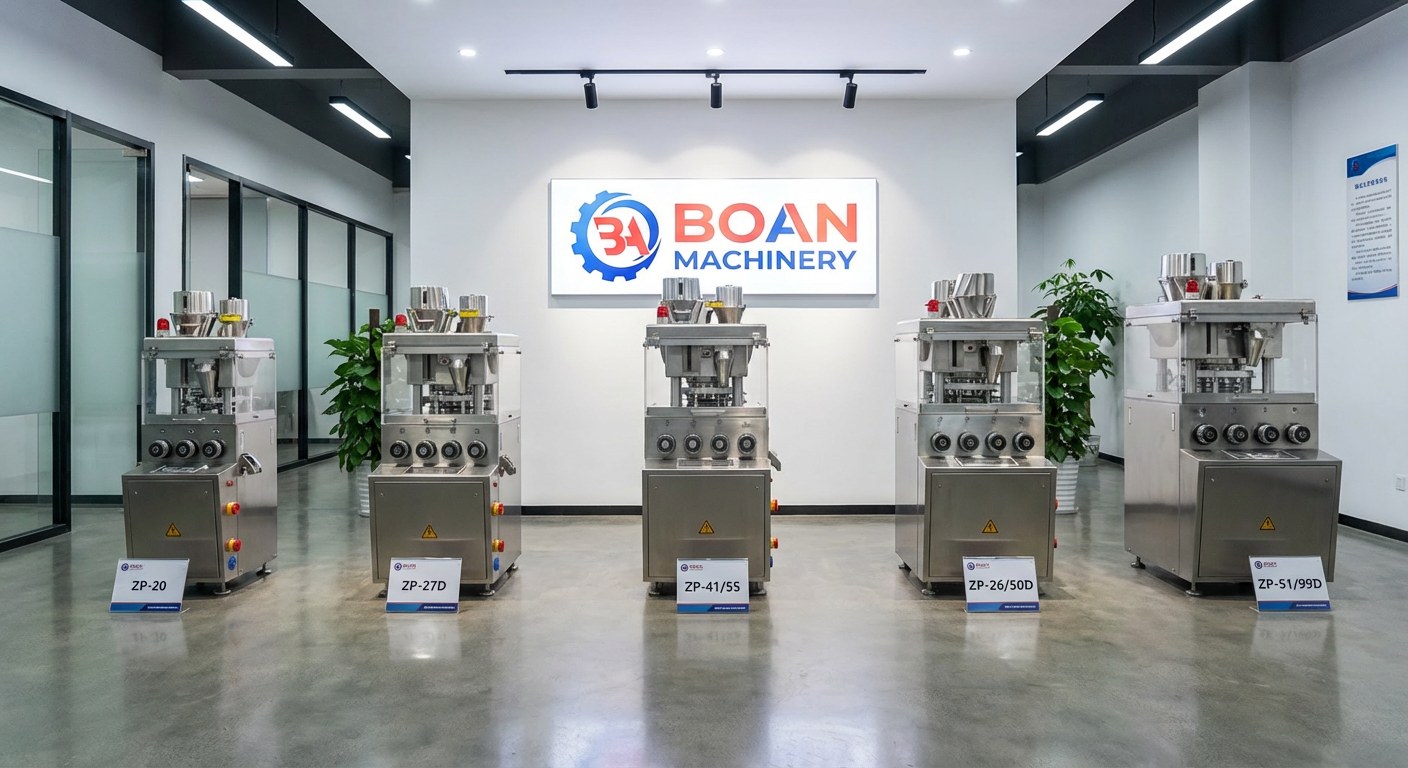
Scenario: Suitable for the high-volume production (e.g., hundreds of millions of units annually) of single-variety, classic tablets such as paracetamol or vitamin C tablets. The core demands of such lines are ultimate efficiency, operational stability, and minimized unit cost.
Solution: Employ a High-Speed Rotary Tablet Press. This equipment features a multi-tip (e.g., 55-75 stations) turret design and uses a forced feeder to ensure uniform die filling. It can maintain a tablet weight variation (RSD) of less than ±2% even at speeds up to 10,000-16,000 tablets per minute. The press is integrated with an In-Process Control (IPC) weight monitoring system for real-time weight checks and automatic rejection of out-of-specification products, complying with FDA 21 CFR Part 11 requirements for electronic records. To meet continuous production needs, it should be paired with an Automated Material Handling System (e.g., elevators, conveyors) and a Metal Detector, forming a closed production unit.
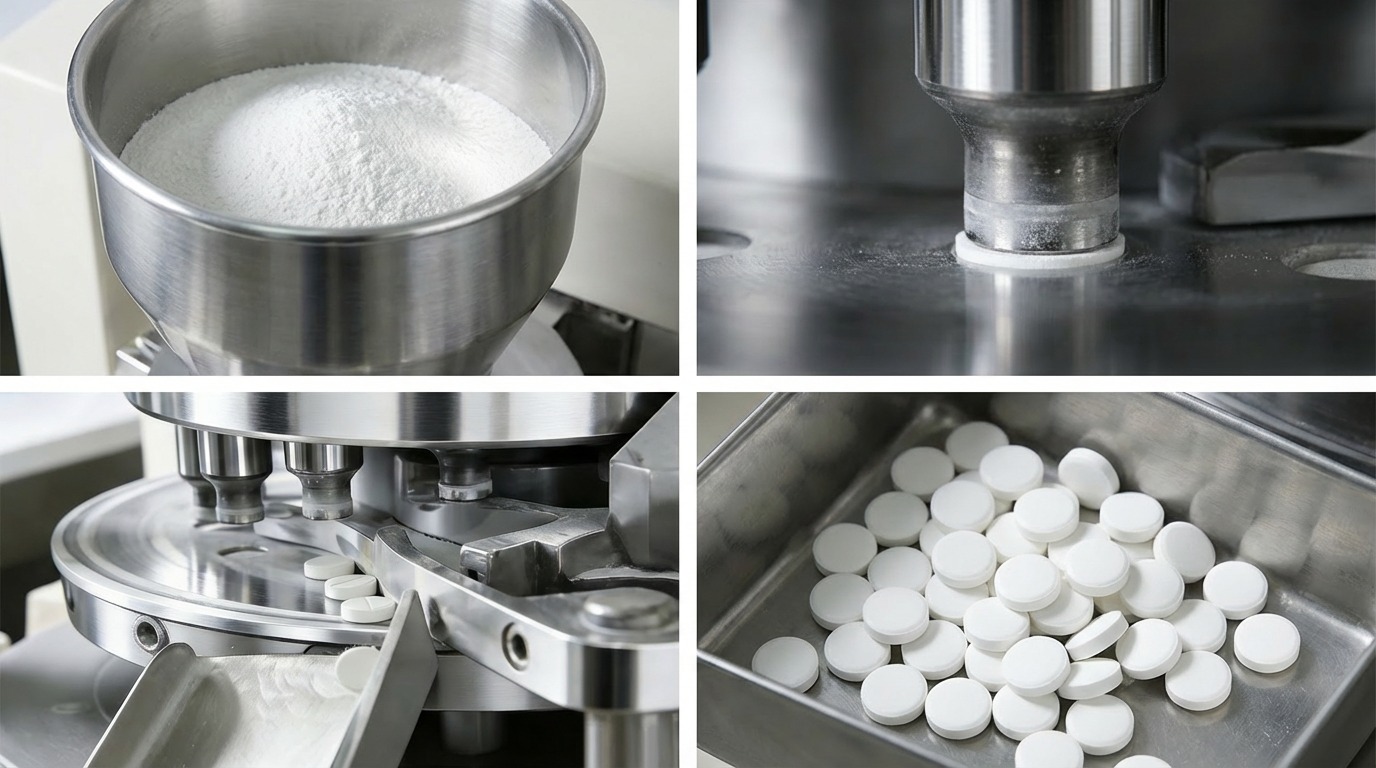
Scenario: Applicable for pilot-scale studies in drug development, clinical trial manufacturing, or facilities producing numerous product varieties (e.g., dozens of SKUs of health supplements). The core challenge lies in frequent product changeovers, small batch sizes, and flexibility.
Solution: Implement a Multi-Function Pilot Tablet Press. While having fewer stations (typically 16-35), its strength lies in superior flexibility and rapid changeover capability. Key features include:
Modular Tooling System: Enables quick changeover of entire turrets or individual punches and dies, reducing cleaning and changeover time to under 30 minutes.
Broad Process Compatibility: Capable of handling a wide range of materials, from free-flowing to highly cohesive powders, and producing shaped or embossed tablets.
Comprehensive Process Analytical Technology (PAT): Integrated sensors for punch pressure, Near-Infrared (NIR) spectroscopy, etc., for process development and optimization.
Forms a complete R&D or small-scale production platform when linked with laboratory-scale mills, mixer-granulators, and coaters.
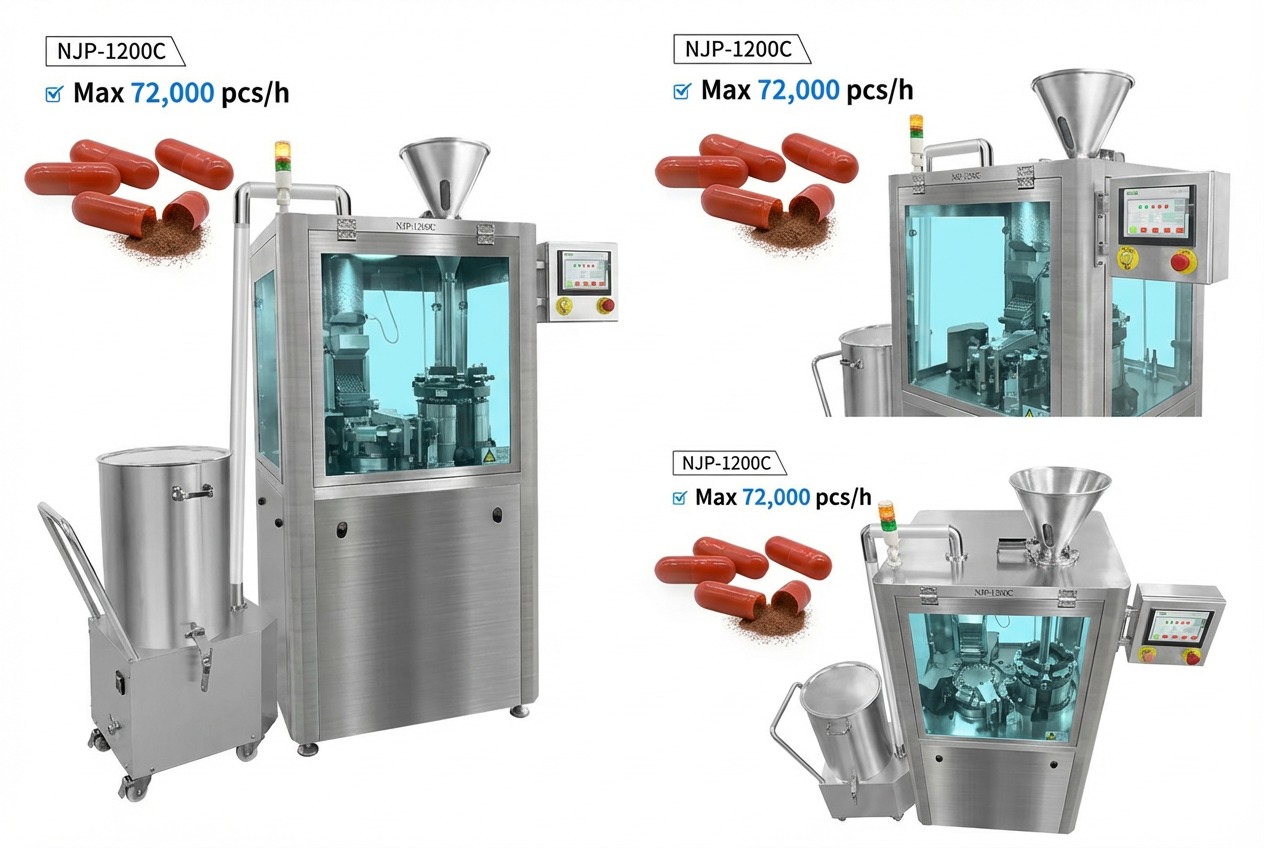
Scenario: Widely used for filling powders, granules, or pellets that are moisture-sensitive, have unpleasant odors, or require modified release. It is the ideal choice for probiotics, herbal extracts, and sustained-release pellets.
Solution: The Modular Fully Automatic Capsule Filling Machine is the mainstream choice. Its operation is based on a continuous "sorting-filling-locking" process. Technical key points include:
Dosing Accuracy Control: Utilizes non-piston dosing systems (e.g., dosing tubes, dosing discs), particularly suitable for poorly flowing materials, achieving fill weight accuracy (RSD) within ±1-3%.
Gentle Pellet Filling: Proprietary pellet filling modules ensure the structure of sustained-release pellets remains intact during the filling process.
In-Process Empty Shell Check and Rejection: Ensures complete separation of empty capsule bodies and prevents empty or poorly joined capsules from entering the finished product stream.
Containment Design: Equipped with local laminar airflow hoods and dust extraction systems, suitable for handling potent compounds (OEB 4/5), and complies with GMP Annex 1 cleanliness requirements.
The following decision matrix integrates considerations of dosage form, capacity, process complexity, and compliance requirements, providing a systematic reference for equipment selection.
| Consideration Dimension | Option A: High-Speed Tablet Line | Option B: Multi-Function Pilot/Small-Batch Line | Option C: Fully Automatic Capsule Line |
|---|---|---|---|
| Best-Suited Dosage Forms | Plain tablets, film-coated tablets | All tablet types (incl. multi-layer, shaped), small-batch capsules | Hard capsules (powder/granule/pellets), especially for moisture-sensitive contents |
| Typical Capacity Range | 500 million - 1.6 billion tablets/year | 10 - 100 million tablets/year, or thousands to millions of capsules/year | 200 million - 1 billion capsules/year |
| Core Process Advantage | Extremely high output, lowest unit cost, highest stability | Extreme flexibility, fast changeover, ideal for process development & complex products | Masks unpleasant taste, protects contents, facilitates modified-release combinations |
| Key Equipment Components | High-speed press + IPC + continuous coater + metal detector | Multi-function press/capsule filler + fluid bed granulator + small coater | Capsule filler + pellet coater + capsule polisher |
| GMP Compliance Focus | Continuous process validation, computerized system validation, cleaning validation | Cross-contamination control (dedicated tools), small batch process validation | Containment, dust control, microbial limit control |
| Total Investment & ROI | Highest investment, suitable for single blockbuster product, ROI from economies of scale | Moderate investment, ROI from multi-product portfolio & fast market response | High investment, ROI from product technical barriers & dosage form advantages |
| Optimal Selection Timing | Stable product market, confirmed annual demand forecast exceeding 300 million units | Product in late-stage clinical or market launch phase, or company adopts multi-product strategy | API has special properties (hygroscopic, bitter), or the capsule form is a key selling point |
Process & Equipment: Direct compression of powder or dry granulation followed by compression. The core equipment is the tablet press. High demands on powder flowability and compressibility often require pre-treatment with air-jet mills and tumble blenders.
Film-Coated Tablets: A polymer film is coated onto compressed cores. Requires a Perforated Coating Pan with integrated spraying systems, hot air circulation, and exhaust/dust collection. Solvent-based coatings necessitate explosion-proof design.
Sugar-Coated Tablets: A complex, multi-layer sugar coating process. Uses traditional coating pans and relies heavily on operator skill, now largely replaced by film coating.
Process & Equipment: Require flavoring agents and fillers like mannitol for palatability. Uses the same equipment as plain tablets but typically requires lower hardness, necessitating attention to the press's compression force control and packaging design to prevent breakage.
Process & Equipment: Combine an acid source (e.g., citric acid) and a base source (e.g., sodium bicarbonate) with the API. The key is strictly controlled low humidity in the production environment (typically RH <25%) and thorough drying of raw materials. The tablet press requires a special moisture-proof feeding system, and packaging must use highly密封的 aluminum-aluminum (Alu-Alu) blisters or specially designed bottles.
Process & Equipment: Used to physically isolate incompatible ingredients or achieve pulsed release. Must use a Multi-Layer Rotary Tablet Press with multiple feeding stations and corresponding turrets for sequential filling and compression of different layers.
Process & Equipment:
Matrix Type: Uses a Hot Melt Extruder to mix the drug with waxy materials, extrude, and cut into pellets for subsequent compression.
Reservoir (Membrane Controlled) Type: Drug-loaded cores or pellets are first prepared, then coated with a release-controlling polymer film in a Fluid Bed Coater with Wurster bottom-spray.
Osmotic Pump Type: Uses a Laser Drilling Machine to create precise release orifices in the coated tablet.
Q: How to verify from an engineering perspective whether a tablet press can meet our product's hardness and friability requirements?
A: Scalability trials are mandatory during equipment selection. Use at least 50kg of actual formulation and run the target machine at 25%, 50%, 75%, and 100% of its designed speed. Systematically sample and test for hardness distribution, friability, content uniformity, and dissolution profile. The equipment is deemed suitable only if all Critical Quality Attributes (CQAs) meet specifications across the entire speed range. This practice applies the "design space" concept from process validation.
Q: What are the special requirements for production line design when manufacturing tablets containing Highly Potent Active Pharmaceutical Ingredients (HPAPIs)?
A: The core principle is "containment." This involves using Isolator Technology to fully enclose the tablet press, with operations conducted via glove ports. The interior maintains negative pressure, and exhaust air is treated through HEPA filters. Material transfer uses Bag-In-Bag-Out (BIBO) systems. Cleaning requires Clean-in-Place (CIP) procedures, validated to ensure residues are below toxicological assessment thresholds (e.g., 1/1000 of the minimum daily dose). Relevant standards can be found in ISPE's "Risk-Based Manufacture of Pharmaceutical Products" guide.
Q: What is the current application status and challenges of Continuous Manufacturing (CM) in solid dosage form production?
A: CM links equipment like continuous mixers, continuous fluid bed dryers, and continuous tablet presses in series for real-time feeding and product output. Advantages include reduced scale, improved quality uniformity (via real-time PAT monitoring), and flexibility. Main challenges involve PAT tool reliability, regulatory acceptance of Real-Time Release Testing (RTRT), and fundamentally different process validation strategies compared to batch production. The FDA has issued guidance encouraging this innovation.
Q: How to systematically address "sticking" issues in tablet production from both equipment and material perspectives?
A: A systematic approach includes: Equipment Side: Ensure punch tip surface finish (Ra value) meets specifications; optimize scraper efficiency of the forced feeder; apply internal die wall lubrication; use a press with a heating system (for low-melting-point materials). Material Side: Optimize the formulation with adequate lubricants (e.g., magnesium stearate) and ensure uniform distribution via micronization.
Q: How to select the production route and equipment for a new sustained-release pellet-in-capsule product?
A: First, define the release mechanism (e.g., diffusion, erosion). A typical route is: Extrusion-spheronization for pellet cores -> Fluid bed Wurster coater for drug layering -> Fluid bed coater for sustained-release coating -> Fully automatic capsule filler with a dedicated pellet filling module. Key selection criteria: precision and atomization of the coater's spray guns; the capsule filler must have a specialized pellet dosing module to ensure gentle filling and dose uniformity.
Q: In cleaning validation, how to determine scientifically sound sampling points and acceptance criteria for a tablet press and capsule filler?
A: Sampling points should be selected based on risk assessment, targeting hardest-to-clean areas (e.g., inside the feeder, deep within die bores, grooves of the dosing disc). The Maximum Allowable Carryover (MACO) should be calculated considering the most stringent of three criteria: 1/1000 of the minimum batch size of the next product, the 10 ppm criterion, and the toxicologically-derived limit (ADE/PDE). A combination of swab and rinse sampling should be used, with demonstrated recovery rates.
Q: What are the essential facility hardware requirements for building a solid dosage form production line compliant with Chinese, US, and EU GMP?
A: Key hardware includes: An HVAC system providing Grade D cleanrooms with Grade A laminar airflow protection over critical points (e.g., compression, filling); Purified Water and potentially Water for Injection systems (for cleaning); Process Compressed Air treated for oil, water, and microbial removal; Facility layout following separation of personnel and material flows to prevent cross-contamination; all product-contact surfaces should be 316L stainless steel with Ra ≤ 0.8 µm.
Q: During tablet coating, how to control process parameters to avoid "orange peel" effect and sticking?
A: Control revolves around the dynamic balance between spray rate, inlet air temperature, atomization pressure, and product temperature. "Orange peel" often results from poor atomization or overly rapid drying; increase atomization pressure, decrease inlet temperature, or increase spray rate. Sticking is caused by excessive moisture; decrease spray rate, increase inlet temperature and pan speed. Modern coaters can employ in-line NIR monitoring of film thickness for closed-loop feedback control.
Q: If the fill weight accuracy of a fully automatic capsule filler shows a continuous decline, what is the troubleshooting procedure?
A: Follow a systematic approach: ① Check if material properties (particle size distribution, moisture content, flowability) have changed. ② Inspect the dosing module (e.g., dosing pins, discs) for wear or clogging. ③ Verify vacuum system pressure stability to ensure complete capsule separation. ④ Check machine leveling and main shaft vibration. ⑤ Confirm the calibration of the IPC check system. Establishing a Preventive Maintenance (PM) schedule for regular inspection of critical parts is recommended.
Q: What are the special considerations in process and equipment for tableting sticky materials like Chinese medicine extract powders?
A: Such materials are highly hygroscopic and adhesive. Process-wise, thorough pre-drying and pretreatment via dry granulation or spray drying are essential to improve flowability. Equipment-wise, select a press with a powerful forced feeder and punches with anti-sticking coatings. The production environment requires strict temperature and humidity control. Tablets should be immediately packaged in Alu-Alu blister packs, and stability under accelerated conditions must be validated.

 Jinhai Plaza, No. 21, Jihua 5th Road, Chancheng District, Foshan City, Guangdong Province, China
  +0757 82252350
  +8618613054883
  manager@gdboanmachine.com