
-
 Call Us +0757 82252350
 -
 Email Us manager@gdboanmachine.com


What Are Pill Capsules Made Of? A Complete Guide to Shell Materials, Manufacturing & Equipment Selection

From two simple shells to a precision carrier for active ingredients, a small capsule conceals the pharmaceutical industry's ultimate pursuit of materials science and production technology.
"The casing of the capsules we take daily is actually a meticulously designed 'molecular gate,'" say engineers testing the dissolution profile of new HPMC capsules in the R&D lab of BOAN Machinery.
The capsule shell material determines how and when it opens—gelatin capsules dissolve rapidly in the gastric acid environment to release their contents, while enteric capsules need to pass through the stomach and reach the intestines to begin functioning.
The global demand for empty capsules exceeds USD 3 billion, with the market share of plant-based capsules growing at over 12% annually. As the need for personalized medicine and precise drug delivery increases, capsules have evolved from simple carriers into a vital component of intelligent drug delivery systems.
Capsules are one of the most common oral dosage forms. Their basic structure mainly consists of two parts: the capsule body and the capsule cap. These fit together precisely to form an enclosed space for the drug contents.
Capsule sizes follow international standards, ranging from large to small in 8 specifications: 000, 00, 0, 1, 2, 3, 4, and 5. Among these, sizes 0 and 1 are the most commonly used, accounting for about 65% of the total market. The fill volume varies from approximately 1.37 ml for size 000 to 0.13 ml for size 5.
Capsules are primarily divided into two major categories: hard capsules and soft capsules. Hard capsules typically consist of two pieces and are suitable for filling powders, granules, or small pellets. Soft capsules are formed from a single sheet and are specifically designed to encapsulate oily liquids, suspensions, or semi-solid substances.
The evolution of materials reflects trends in the pharmaceutical industry. From traditional gelatin to plant-based materials, technological innovation in capsule shells has never ceased. Modern capsule technology can already achieve various functions such as timed release, targeted release, and controlled-rate release.
The material of the capsule shell directly affects the drug's stability, release characteristics, and patient acceptance. Currently, mainstream market materials fall into three major categories: animal-derived gelatin, plant-based cellulose derivatives, and specialty polymers.
Gelatin capsules are derived from animal collagen, with primary sources including bovine bones, porcine skin, and fish scales. This material offers good film-forming properties, elasticity, and rapid dissolution, with relatively low production costs. Its long history of application makes it one of the most mature capsule materials.
However, gelatin capsules have notable limitations: they are sensitive to temperature and humidity, requiring strict storage conditions; their animal origin makes them unsuitable for vegetarians, followers of certain religions, and some individuals with allergies.
Vegetarian capsules primarily use hydroxypropyl methylcellulose (HPMC), a plant cellulose derivative extracted from pine wood or cotton linters. HPMC capsules offer excellent stability, are insensitive to humidity changes, and are fully suitable for vegetarians and various religious dietary rules.
A more premium plant-based material is pullulan, produced through the fermentation of starch. It features extremely high transparency and purity. Pullulan capsules barely interact with their contents, making them an ideal choice for high-end health products and sensitive drugs, though production costs are correspondingly higher.
Faced with a variety of capsule materials, manufacturers need to make informed choices based on product characteristics, target markets, and regulatory requirements. The decision on capsule material will directly impact the product's market acceptance, stability, and production costs.
Gelatin capsules are suitable for most conventional drugs and health products, especially cost-sensitive products. They dissolve quickly, making them suitable for formulations requiring rapid onset of action. However, for ingredients containing aldehyde groups, strong acids or bases, or those prone to moisture absorption, gelatin may not be the best choice.
HPMC capsules are better suited for sensitive ingredients, such as probiotics, enzyme preparations, and certain herbal extracts. Their low oxygen permeability and pH stability better protect the contents. The advantages of HPMC capsules are particularly evident in high-temperature and high-humidity climates.
The choice between soft and hard capsules depends on the physical form of the contents. Oily liquids, volatile oils, and low-melting-point substances typically require soft capsule encapsulation, while powders, granules, and dry extracts are more suitable for hard capsules. The production process for soft capsules is more complex, requiring specialized rotary die encapsulation equipment.
Capsule size selection is equally important. Low-density plant extracts often require larger capsules (e.g., size 00), while high-density chemical active pharmaceutical ingredients can use smaller sizes (e.g., size 3 or 4). Accurate calculation of fill volume is key to avoiding waste and ensuring dosage consistency.
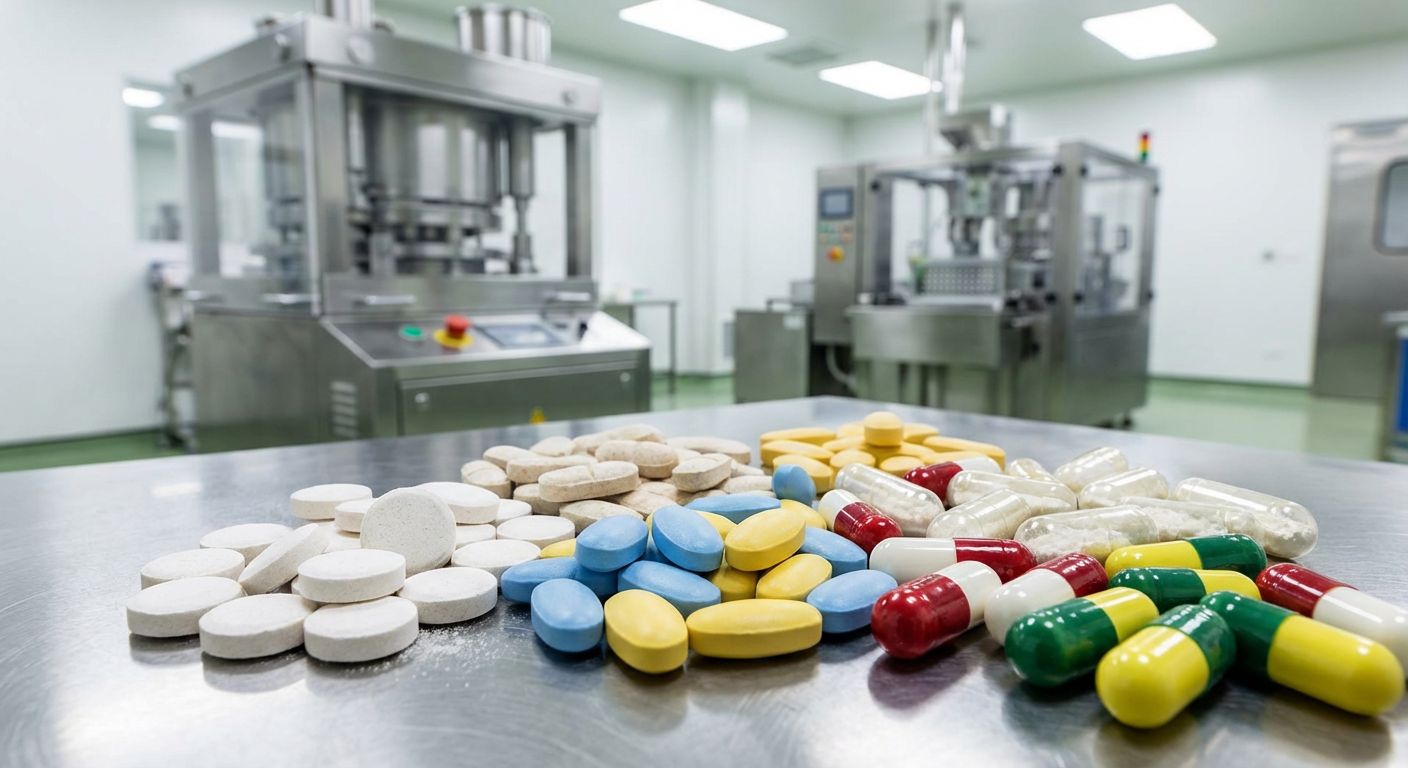
The capsule production process may seem simple but is full of technical challenges. From raw material handling to final packaging, every step requires precise control and professional technical support; otherwise, it may lead to an entire batch failing quality standards.
The basic capsule manufacturing process includes: raw material preparation, gel solution preparation, dipping and forming, drying and cutting, filling, joining, polishing and inspection, and packaging. For soft capsules, additional steps such as content preparation, encapsulation, and setting and drying are required.
Powder flow control is a major challenge in hard capsule production. Fine powders easily form "bridging" in the hopper, leading to uneven filling, while coarse particles may clog the feeding holes. Ideal powder should have an appropriate particle size distribution and flow characteristics; flow aids can be added if necessary to improve performance.
Capsule deformation and breakage are another common issue. Gelatin capsules become brittle in environments with humidity below 35% and soften or stick together above 65% relative humidity. Control of the production environment's temperature and humidity is crucial, typically needing to be maintained within 45-55% relative humidity and 20-25°C.
Modern capsule filling equipment integrates various solutions to address these challenges. Vibration-assisted feeding systems prevent powder bridging; servo-controlled precision plungers ensure filling weight consistency; and online weighing systems can monitor and adjust the fill weight of each capsule in real-time.
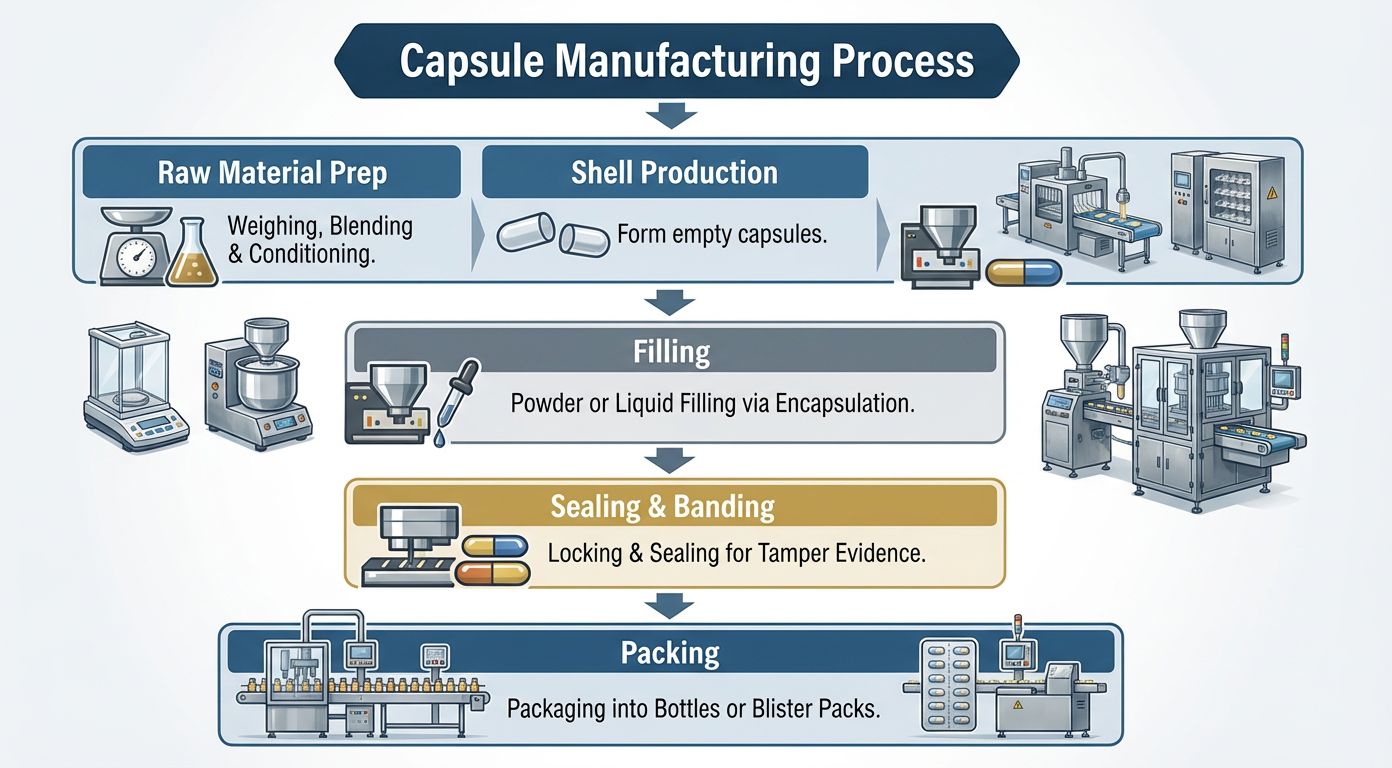
Selecting the appropriate capsule production equipment is fundamental to ensuring product quality and production efficiency. From small-scale laboratory equipment to high-speed production lines with hourly outputs of tens of thousands of capsules, equipment selection should be based on actual needs, product characteristics, and development plans.
Production capacity is the primary consideration. Small semi-automatic equipment is suitable for the R&D phase and initial production, offering operational flexibility but limited efficiency. Fully automatic high-speed production lines are suitable for large-scale production; although the initial investment is higher, long-term operational costs are lower.
There are various types of capsule filling machines, including disc fillers, dosing disc fillers, and continuous fillers. Disc fillers are simple to operate, suitable for multi-variety, small-batch production. Dosing disc fillers offer high precision, suitable for products with strict dosage uniformity requirements. Continuous fillers offer the highest efficiency, suitable for large-scale production of single varieties.
Equipment compatibility with capsule materials is equally important. Traditional equipment is mainly designed for gelatin capsules, while plant-based capsules may require adjustments to mold dimensions and temperature/humidity parameters. Choosing equipment that can flexibly adapt to various materials leaves room for future product upgrades.
Maintenance, upkeep, and cleaning convenience are often overlooked but directly impact equipment utilization and product quality. Modular design, easy disassembly, and surfaces finished to GMP standards can significantly reduce equipment downtime and cleaning difficulty.
The capsule equipment series from BOAN Machinery provides diversified solutions for different production needs. Our R&D team continuously monitors the latest developments in materials science and pharmaceutical technology, ensuring our equipment technology remains at the forefront of the industry.
On the capsule production line, the final set of inspected HPMC capsules passes through the optical inspection system at a speed of 3000 capsules per minute. Under blue light illumination, any minor defect or contamination becomes visible; only flawless capsules proceed to the packaging stage.
Driven by the growth of vegetarianism and special dietary needs, the market share of plant-based capsules has risen from 15% to 34% within five years. New materials like alginate and zein are also showing potential in laboratories and may change the landscape of the capsule industry in the next decade.
The evolution of the capsule is a journey intertwined with materials science and pharmaceutical engineering. Each seemingly simple capsule carries humanity's relentless pursuit of precise drug delivery.
1. What are the main materials for capsule shells?
There are three main categories: animal-derived gelatin (from cattle, pigs, or fish), plant-based materials (like hydroxypropyl methylcellulose/HPMC and pullulan), and specialty polymers (used for enteric or sustained-release capsules).
2. Which is better, gelatin capsules or plant capsules?
Each has its advantages. Gelatin capsules are lower cost, dissolve quickly, and the technology is mature. Plant capsules are suitable for vegetarians and specific dietary requirements, offer higher stability, and are less sensitive to temperature and humidity. The choice depends on product positioning, target audience, and budget.
3. What are the standard capsule size specifications?
International standard capsule sizes range from large to small in 8 specifications: 000, 00, 0, 1, 2, 3, 4, and 5. The most commonly used are sizes 0 and 1, which can hold approximately 0.68ml and 0.50ml of contents, respectively.
4. Why are some capsules transparent and others opaque?
Transparency depends on the material. Pullulan capsules have the highest transparency, HPMC is next, and gelatin capsules are typically semi-transparent to opaque. Some opaque capsules may have opacifying agents added to protect light-sensitive ingredients.
5. What is the main difference between soft capsules and hard capsules?
Soft capsules are formed from a single sheet, primarily encapsulating oily or liquid contents. Hard capsules consist of two pieces and are suitable for powders, granules, or pellets. Their production processes and equipment are completely different.
6. What are common quality issues in capsule production lines?
Common problems include: uneven fill weight (caused by poor powder flow), capsule deformation and breakage (improper temperature/humidity control), poorly joined capsules (mold wear or locking mechanism failure), and appearance defects (issues with gel solution preparation or dipping process).
7. How can capsule filling accuracy be improved?
The following measures can be taken: optimize the powder's particle size distribution and flowability, use servo-controlled precision filling mechanisms, install online weight detection and feedback systems, and maintain a stable production environment temperature and humidity.
8. How do enteric capsules achieve intestinal release?
Enteric capsule shells have special polymers added (such as cellulose acetate phthalate). These materials remain stable in the gastric acid environment and only dissolve in the higher pH environment of the intestines, thereby achieving targeted intestinal release.
9. What key factors should be considered when selecting a capsule filling machine?
Considerations should include: production capacity and speed requirements, filling accuracy, compatibility with capsule sizes and materials, ease of equipment cleaning and maintenance, compliance with GMP standards, and the supplier's technical support capabilities.
10. What are the future trends in capsule technology?
Major trends include: broader application of more plant-based and sustainable materials, intelligent capsules (e.g., with sensors to monitor conditions in the body), personalized dosage capsules, and more precise targeted release technologies.

 Jinhai Plaza, No. 21, Jihua 5th Road, Chancheng District, Foshan City, Guangdong Province, China
  +0757 82252350
  +8618613054883
  manager@gdboanmachine.com